
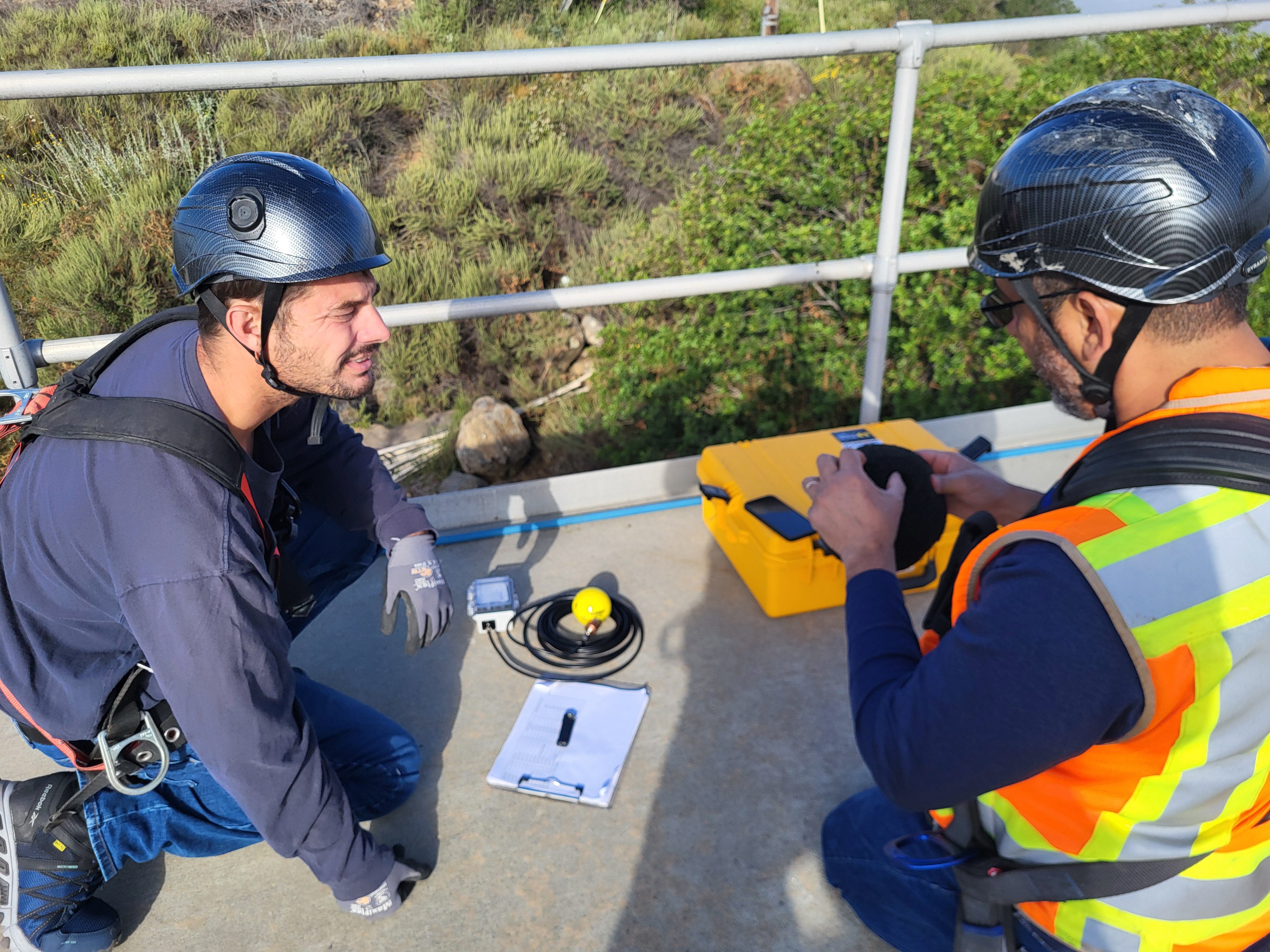
On April 8, the Water Authority’s Aqueduct Integrity team deployed a new leak detection device into the First Aqueduct Pipeline 2, and 16 miles later they retrieved it to find that the device had done exactly what it was meant to do.
In its inaugural deployment, the device determined there were no leaks in that portion of Pipeline 2, one of the San Diego region’s major water conveyance lines managed by the Water Authority.
As important as that finding was, what stood out even more was that the team’s vision on how to perform such inspections in-house while saving the Water Authority and its member agencies hundreds of thousands of dollars had been realized.
“For me, there was a sense of euphoria,” said team member Erick Pate, Principal Asset Management Specialist. “We were able to deploy it in Escondido and 16 miles later, we retrieved it. The moment was palpable. I might have raised my arms in a ‘V’ for that victory.”
For their vision, the members of the Aqueduct Integrity team won the 2025 Innovation Award, presented by the Water Authority’s Innovation Committee during the February GM Quarterly Briefing.
The award is granted as part of the committee’s Bright Idea Program, which collects innovative ideas throughout the organization, empowering staff to improve efficiency, solve problems creatively, and drive impactful change.
“We’re excited to recognize the Aqueduct Integrity team for their outstanding contribution to the Water Authority’s Innovation Program,” said Innovation Committee Chair Maria Rose. “Bringing leak detection work in house with a specialized device is a great example of how innovation can save money, build our expertise, and strengthen our system. This is exactly the kind of creativity and initiative that moves our organization forward.”
The Aqueduct Integrity team submitted its leak detection device plan in April 2025 to the Bright Idea Program.
The team’s idea involved purchasing a specialized leak detection device and performing the pipeline inspections with Water Authority staff as opposed to hiring outside contractors to perform the task.
“It was an idea that could bring significant savings,” said Martin Coghill, Operations and Maintenance Manager, and a member of the team.
Coghill estimates that performing the inspections in-house, for example, on all 61 miles of the parallel Pipelines 1 and 2 would save the Water Authority some $800,000 in contractor costs. Those savings could eventually reach into the millions of dollars as the device determines pipelines are in good working order without the need for immediate repairs.
The device was purchased for just under $50,000, but it will ultimately be zero cost to the Water Authority through a reimbursement from a Metropolitan Water District of Southern California grant program.
The device is a free-swimming, multi-sensor sphere roughly the size of a softball that is deployed into a pipeline and is propelled by the flowing water. While traversing the pipeline, the device records data based on acoustic activity that would indicate leaks in the joints, which would otherwise not be detected by other condition assessment methods.
During the April 8 deployment, the only leak the device detected was simulated by the team to test the device. The device successfully recorded the simulation, providing certainty that it performed properly, and that the 16-mile section of pipeline was free of actual leaks.
At the end of its run, the sphere was captured by a catch-net system the team had set up across the open-channel section of the bifurcation structure leading to the Poway Tunnel. The device’s total run-time through the pipeline was eight hours.
“In this case, we realized we can deploy the device ourselves and get the data and interpret it ourselves,” said team member Daniel Ramirez, Asset Management Specialist I.
Team member William Tsueng, Senior Asset Management Specialist, added, “When we caught the tool, there was a real sense of validation. There was actual proof we could pull this off ourselves.”
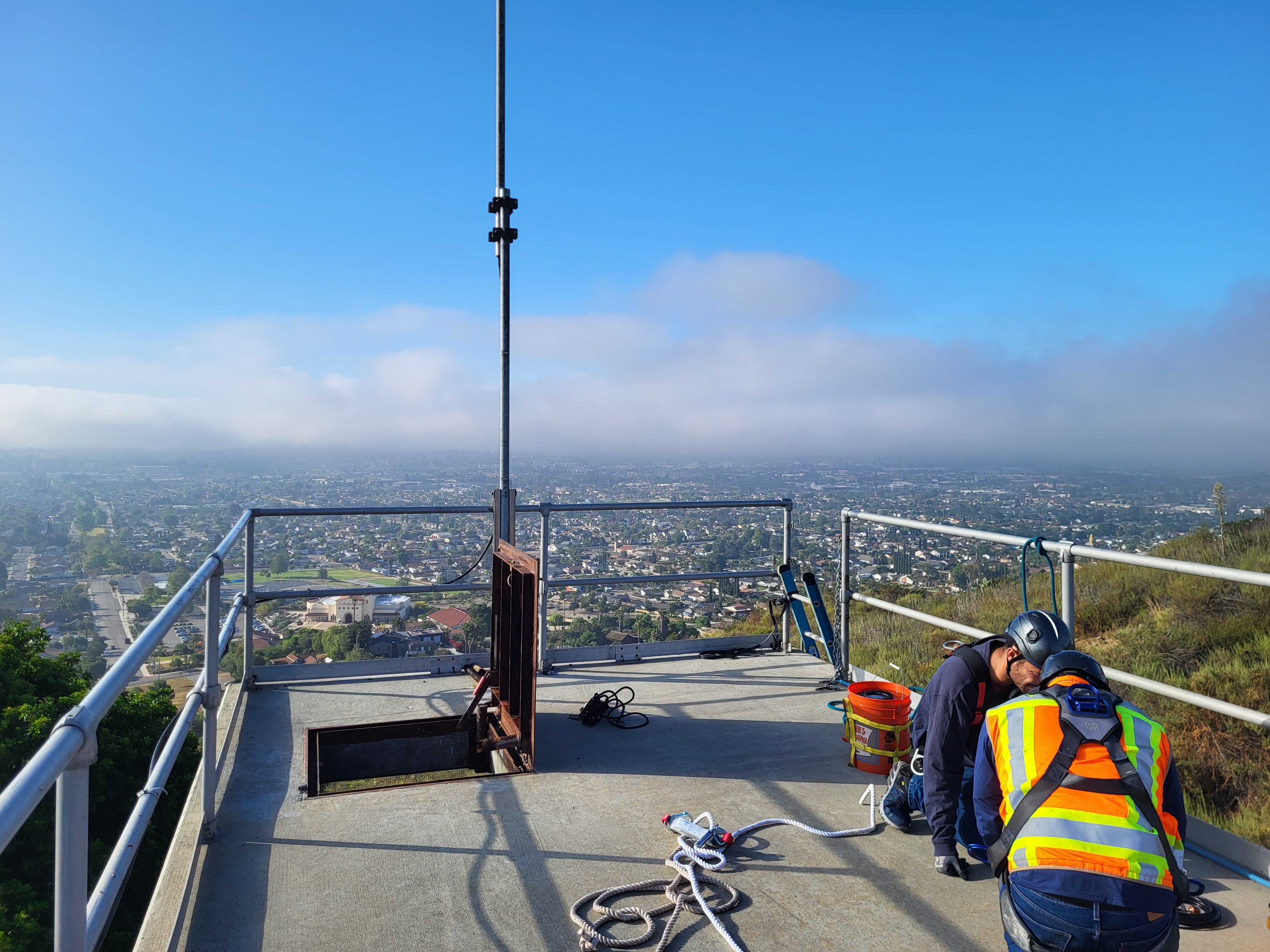
The deployment was also a success because it proved leak detection efforts can be done without shutting down a pipeline, which results in saving time and money, and ensuring water continues to flow without interruption.
“Shutdowns are expensive and take a lot of time,” said Josh Itzaina, Asset Management Specialist II and a team member.
April’s deployment was a joint effort of the Aqueduct Integrity team and other crews from Operations and Maintenance. “There was a sense of teamwork that went into this project,” Pate said. “The other staff in Operations and Maintenance were just as invested in this as we were.”
“It wasn’t just a win for us,” added Pate. “It was a win for Operations and Maintenance and the Water Authority as a whole.”
Looking ahead, the team said they are anticipating another deployment of the device within the next 12 months.
As for the Bright Idea Program, Coghill said any team can introduce innovative ideas within their own department. If anyone wants to submit an idea to the program, it can be done on the Water Authority intranet site under the “Submit a Bright Idea” tab.
For questions about submitting, reach out to Maria Rose at mrose@sdcwa.org or at 858-522-6751.